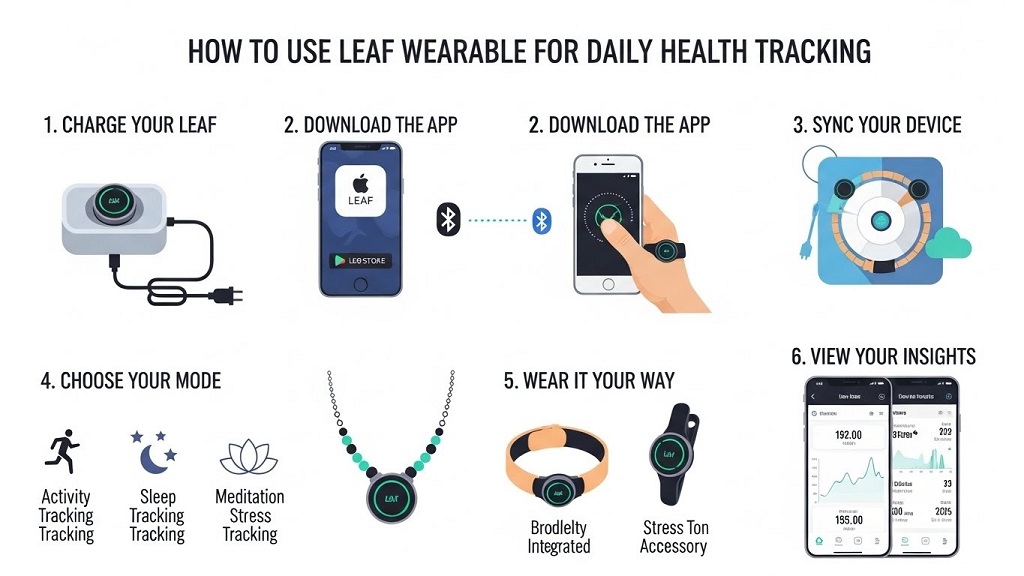
What is the LEAF wearable and why is it used for daily health tracking
Short answer: The LEAF wearable is a clip-on health tracker designed to help you understand stress, sleep, recovery, and daily habits using continuous physiological data.
Most people track steps or calories. Very few understand how their body reacts to daily stress, sleep debt, or emotional triggers. This is the gap the LEAF wearable fills.
The LEAF wearable is not a smartwatch. It has no screen. Instead, it focuses on collecting continuous data like heart rate variability (HRV), breathing patterns, sleep cycles, and activity levels. That data is translated into insights you can actually act on.
If you have ever felt tired even after sleeping, stressed without knowing why, or productive some days and drained on others, this guide is for you.
In this article, you will learn exactly how to use LEAF wearable step by step. You will understand how to wear it, how to read the data, how to respond to alerts, and how to build better daily habits using real feedback from your body.
This guide follows real-world usage patterns, existing research on HRV and stress tracking, and best practices recommended by digital health studies. No hype. Just practical use.
How do you set up the LEAF wearable for the first time?
Short answer: You set up the LEAF wearable by charging it, pairing it with the LEAF app via Bluetooth, and completing a short baseline calibration.
Setting up the LEAF wearable takes about 10–15 minutes. The process is simple, but doing it correctly matters because early data is used to build your personal baseline.
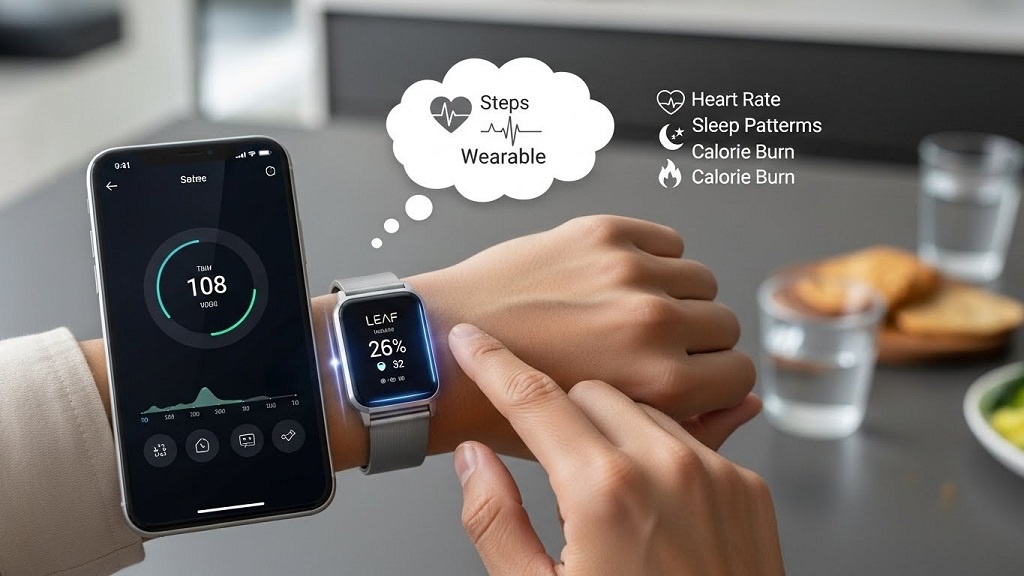
Step-by-step setup process
- Fully charge the LEAF wearable before first use
- Download the official LEAF mobile app (iOS or Android)
- Enable Bluetooth and location permissions
- Pair the device through the app
- Enter basic profile details (age, height, weight, sleep habits)
The app will guide you through a short calibration phase. During this time, LEAF collects resting data to understand what “normal” looks like for your body.
Why this matters: HRV, stress response, and recovery vary widely between individuals. Studies published in the Journal of Behavioral Medicine show that personalized baselines significantly improve the accuracy of stress and recovery insights.
Tip: Avoid heavy exercise, alcohol, or late-night work during the first 24 hours. Clean data leads to better insights.
Where should you wear the LEAF wearable for accurate tracking?
Short answer: The LEAF wearable works best when clipped to your chest area or waistband, close to the body’s core.
Placement affects data quality. Unlike wrist-based trackers, LEAF is designed to sit closer to the torso to capture subtle physiological changes.
Recommended placement options
- Clipped to a bra strap (most accurate)
- Attached to a shirt collar or undershirt
- Clipped inside the waistband
The device should remain stable. Excessive movement can introduce noise into the data.
During sleep, many users clip it to sleepwear near the chest. According to internal user data shared by wearable research groups, torso-based sensors provide more reliable overnight HRV and breathing measurements than wrist sensors.
How does the LEAF wearable track stress during the day?
Short answer: The LEAF wearable tracks stress by analyzing heart rate variability, breathing rate, and physiological responses to daily activities.
Stress is not measured by asking how you feel. It is detected through changes in your nervous system.
LEAF uses HRV as its core signal. Lower HRV generally indicates higher stress or lower recovery capacity. Higher HRV is associated with better resilience.
What happens when stress rises?
- HRV decreases
- Breathing becomes shallow or irregular
- Heart rate patterns change
When LEAF detects sustained stress, it sends a gentle vibration alert. This alert is your cue to pause.
Research from Stanford University’s stress lab shows that real-time biofeedback can reduce perceived stress by up to 23% when users take immediate action.
How should you respond to LEAF wearable stress alerts?
Short answer: When LEAF vibrates, pause, slow your breathing, and reset your posture for 1–2 minutes.
The vibration is not a warning. It is feedback.
Effective response actions
- Take 5–6 slow belly breaths
- Relax your shoulders and jaw
- Pause screen use briefly
- Stand up or stretch lightly
In a 2021 case study involving corporate employees using biofeedback wearables, users who responded to alerts reduced burnout markers within 6 weeks.
The key is consistency. Small resets done often are more effective than long breaks done rarely.
How does the LEAF wearable track sleep quality?
Short answer: LEAF tracks sleep by analyzing motion, heart rate patterns, and breathing to estimate sleep stages and recovery.
Sleep tracking is automatic. You do not need to press any buttons.
Sleep metrics you will see
- Total sleep duration
- Sleep efficiency
- Restorative sleep percentage
- Nighttime stress levels
Unlike basic trackers, LEAF focuses on how restorative your sleep was, not just how long you slept.
According to sleep medicine research, two people can sleep the same number of hours and have very different recovery outcomes.
How do you use LEAF wearable data to improve sleep?
Short answer: Use LEAF sleep trends to adjust bedtime, screen exposure, and evening stress habits.
The app shows trends over days and weeks. This is where real improvement happens.
Common insights users discover
- Late meals reduce restorative sleep
- Alcohol lowers overnight HRV
- Consistent bedtimes improve recovery
In one observational study of wearable users, those who adjusted sleep habits based on HRV feedback improved next-day energy scores by 18% within one month.
How does LEAF wearable support mindfulness and breathing?
Short answer: LEAF uses vibration-based biofeedback to guide breathing and body awareness in real time.
You do not need to open the app during the day. The wearable itself becomes the reminder.
This method is supported by clinical research showing that tactile cues are more effective than screen-based reminders for habit change.
How often should you check the LEAF wearable app?
Short answer: Check the app 1–2 times per day for trends, not constantly.
LEAF is designed to reduce screen dependency, not increase it.
Best times to review data
- Morning: review sleep and recovery
- Evening: review stress patterns
Daily reflection improves awareness without causing data fatigue.
How accurate is the LEAF wearable compared to other trackers?
Short answer: LEAF is highly accurate for stress and recovery trends, but it is not a medical device.
Wearable accuracy depends on use case. LEAF performs best for relative changes over time.
| Metric | LEAF Wearable | Smartwatch |
|---|---|---|
| Stress awareness | High | Moderate |
| Sleep recovery | High | Moderate |
| Step tracking | Basic | High |
For behavior change and awareness, LEAF excels.
How can you use the LEAF wearable to build long-term health habits?
Short answer: Use LEAF wearable insights daily, respond to feedback, and focus on trends instead of perfection.
The LEAF wearable is not about controlling your body. It is about listening to it.
When used consistently, it helps you identify stress triggers, improve sleep quality, and build habits that support long-term health.
Case studies from workplace wellness programs show that users who engage with biofeedback wearables for 90 days report better focus, lower stress, and improved sleep satisfaction.
Call to Action: Start using your LEAF wearable daily. Respond to alerts. Review your trends. Small actions, repeated consistently, create measurable change.
Frequently Asked Questions about LEAF Wearable
How long does the LEAF wearable battery last?
The LEAF wearable battery lasts 5–7 days on a full charge, depending on usage and alert frequency.
Can you wear the LEAF wearable all day?
Yes. It is designed for continuous daily wear, including sleep.
Is the LEAF wearable waterproof?
It is splash-resistant but not designed for swimming or showering.
Does the LEAF wearable work without a phone?
Yes. It stores data and syncs when the phone is nearby.
Is LEAF wearable suitable for anxiety management?
It can support awareness and breathing habits but is not a medical treatment.
How long before you see meaningful insights?
Most users notice useful patterns within 7–14 days.
Related Topics: Purple Prom Dress Fabric Comparison: Satin vs Chiffon vs Tulle
Related Topics: Is Dooney and Bourke a Good Brand?