You are standing at the boarding gate, and the gate agent is eyeing your bag like a hawk. You swore it would fit under the seat, but now you are not so sure. We have all been there. Choosing the right personal item backpack for airplane travel is the difference between a stress-free boarding experience and last-minute gate checking fees. This guide will help you cut through the noise and find a bag that fits, protects your gear, and saves you money without looking like you are carrying a hiking tent.
What Exactly Defines a Personal Item Backpack for Airplane Travel?
A personal item backpack is a small bag you can stow completely under the seat in front of you. It is distinct from a carry-on, which goes in the overhead bin. Most airlines enforce strict size limits for these bags, typically around 18 x 14 x 8 inches. If your backpack exceeds these dimensions, you risk being forced to check it at the gate, often with an extra fee. The key is that a personal item must fit entirely within the sizer box at the airport. Unlike a carry-on, you do not pay an extra fee for a personal item on most airlines, including budget carriers like Spirit, Frontier, and Ryanair. This makes it a critical tool for budget-conscious travelers.
Why Should You Use a Backpack Instead of a Tote or Duffel for Flying?
Backpacks distribute weight evenly across your shoulders, leaving your hands free for your passport, phone, and coffee. This is a major advantage over totes, which strain one side of your body, and duffels, which are awkward to carry through a crowded terminal. A good personal item backpack also offers superior organization with dedicated compartments for a laptop, tablet, and liquids bag. When you are rushing through security, having a backpack that opens flat and has a quick-access pocket for your boarding pass can save you precious minutes. Furthermore, backpacks are more secure. You can wear them on your front in crowded spaces, making it much harder for pickpockets to access your valuables.
What Are the Essential Features of a Personal Item Backpack for Airplane Travel?
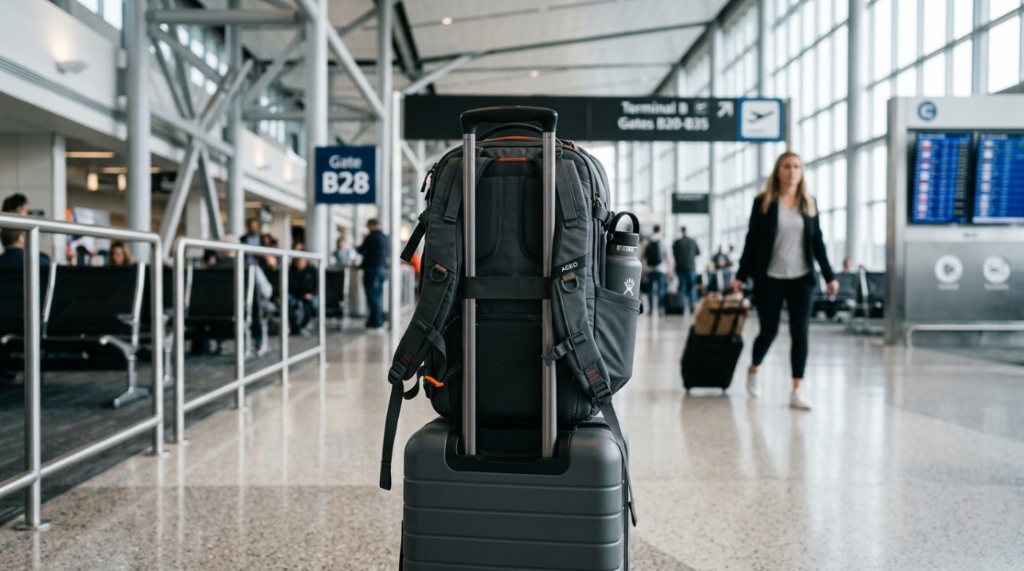
Not every backpack is built for the unique demands of air travel. You need specific features to ensure a smooth journey. The most critical feature is the internal frame or structure. A bag that collapses into a floppy shape is hard to pack efficiently and often does not stay seated under the seat. Look for a bag with a semi-rigid back panel. Another must-have is a luggage pass-through sleeve. This is a strap on the back of the bag that slides over the handle of your rolling suitcase. This turns your two separate bags into one stable unit, significantly reducing fatigue in a long terminal. Water bottle pockets are also non-negotiable, but make sure they are angled forward so you can access your bottle without taking the bag off. Finally, clamshell opening is superior to a top-loading design. It allows you to lay the bag flat on a hotel bed and see all your contents instantly.
How Do You Measure a Backpack to Fit Airline Personal Item Size Restrictions?
You cannot rely on the manufacturer’s listed dimensions alone. You must measure the bag yourself when it is packed full. Start by packing the bag exactly as you would for travel. Then, use a rigid measuring tape to measure the height (top to bottom), width (side to side), and depth (front to back). The depth measurement is the most commonly overlooked dimension. Many bags appear small but swell out when packed, exceeding the 8-inch depth limit common on budget airlines. If you frequently fly Spirit or Frontier, aim for a bag that is no taller than 18 inches, no wider than 14 inches, and no deeper than 8 inches. For standard Delta or United flights, you usually have a bit more room, but the same principle applies. A good test is to see if your packed bag fits inside a standard milk crate, which approximates the size of an airline sizer.
Which Airline Has the Strictest Personal Item Size Rules?
Budget airlines are the most strict, and Ryanair is often cited as the toughest. Their personal item limit is 15.7 x 11.8 x 7.9 inches, which is smaller than most other carriers. Spirit Airlines is also notoriously strict, with a limit of 18 x 14 x 8 inches. However, they are known for having gate agents who actually measure bags. If you fly these airlines regularly, you need a dedicated personal item backpack backpack for airplane travel designed specifically to meet these tight dimensions. Full-service carriers like American or Lufthansa are usually more lenient, but you should still aim to stay within the published limits to avoid any risk. The safest strategy is to optimize for the strictest airline you fly, even if you only use it once a year.
How Should You Pack a Personal Item Backpack for Maximum Space and Organization?
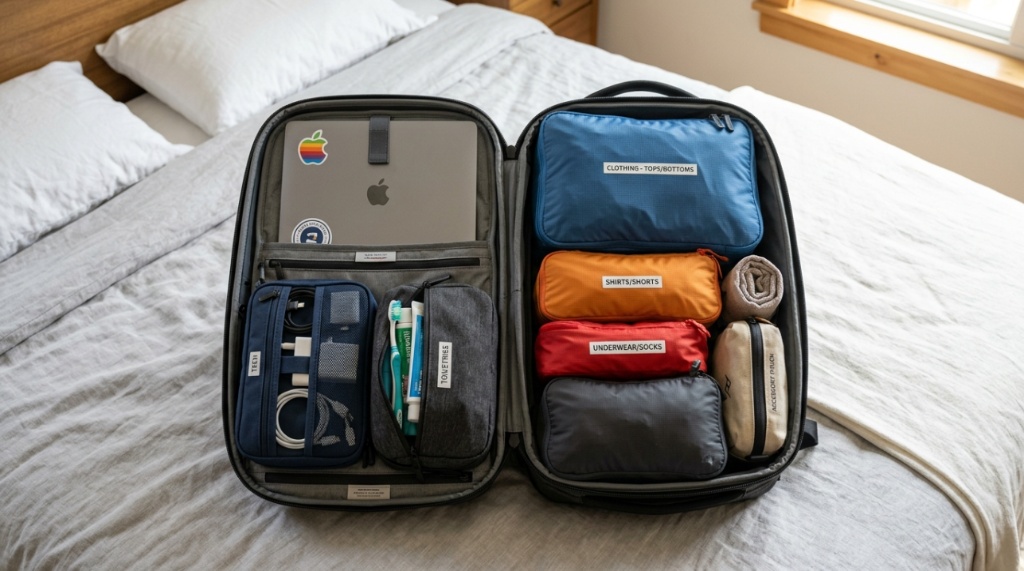
Packing a small bag requires strategy. You cannot just throw things in. Use packing cubes to compress your clothing and keep similar items together. Roll your clothes instead of folding them to save space and reduce wrinkles. Place your heaviest items, like a laptop and toiletry bag, closest to your back. This creates a better center of gravity and makes the bag feel lighter. Use the front compartment for items you will need during the flight, such as a neck pillow, snacks, and a tablet. The best trick is to use the “burrito method.” Lay a jacket or sweater flat on the bottom of the packing cube, place your rolled clothes on top, then fold the jacket over them. This creates a tight, compressed bundle that maximizes every inch. Do not forget to use the top pocket for your liquids bag to speed up security checks.
Can You Bring a Laptop in a Personal Item Backpack?
Yes, absolutely. In fact, a personal item backpack is the ideal place for a laptop because it fits under your seat, keeping your expensive electronics close at hand and safe from overhead bin jostling. However, not all backpacks are laptop-friendly. You need a bag with a dedicated, padded laptop sleeve that is suspended off the bottom of the bag. A suspended sleeve means that if you drop the bag, the laptop does not hit the ground directly. The sleeve should fit a 13-inch or 14-inch laptop comfortably. If you carry a 15-inch or larger workstation, you need to check the sleeve dimensions carefully, as many personal item packs are too small for these larger machines. Also, remember that the laptop counts toward your weight allowance if the airline has one, so keep it light.
Is a Soft-Shell or Hard-Shell Backpack Better for Airplane Travel?
A soft-shell backpack is almost always the better choice for a personal item. Soft-shell bags are flexible, allowing you to compress them slightly to fit into a tight sizer. They are also lighter, which is critical when airlines weigh your bag. Hard-shell backpacks, sometimes marketed as “personal item cases,” look sleek but are rigid. If they are even a quarter-inch too big, you cannot physically force them into the sizer. Soft-shell bags also have external pockets for water bottles and quick-access items, which hard-shell bags typically lack. The only advantage of a hard shell is superior protection for fragile items like camera equipment. For 99% of travelers, a well-padded soft-shell backpack is the most versatile and practical option.
What Are the Best Materials for a Durable Personal Item Backpack?
Look for backpacks made from ripstop nylon or high-density polyester. Ripstop nylon is woven with a reinforced grid pattern that prevents tears from spreading. It is also water-resistant, which is essential for protecting your laptop and documents from rain or spills. Ballistic nylon is even more durable and is often used in tactical gear, but it is heavier. Avoid cheap “polyester 600D” without a waterproof coating, as this material can soak through in a light rain. Check the zippers, too. YKK zippers are the gold standard. They are less likely to fail under pressure. Also, look for reinforced stitching at stress points, like the handle and shoulder strap attachments. A bag that costs $80 but is made with poor materials will likely fall apart after a few trips, costing you more in the long run.
How Do You Clean and Maintain a Travel Backpack?
Regular maintenance extends the life of your bag significantly. Between trips, empty the bag completely and shake out any crumbs or debris. Use a lint roller to clean the inside of the main compartment and pockets. For deeper cleaning, spot-clean the exterior with a soft cloth and mild soap mixed with water. Do not put your backpack in the washing machine, as this can damage the internal frame and padding. Instead, hand-wash it in a tub of cool water with a small amount of gentle detergent. Rinse thoroughly and let it air dry completely away from direct heat sources. Dry any damp pockets with a microfiber cloth to prevent mildew. Finally, lubricate the zippers with a silicone-based lubricant once a year to keep them moving smoothly.
Which Backpack Style Is Best for Women vs. Men?
Biologically, the fit is more important for women than the color or pattern. Women generally have shorter torsos and narrower shoulders than men of the same height. A unisex backpack might fit a woman poorly, causing the hip belt to sit too low or the shoulder straps to dig in. Look for backpacks specifically designed with women’s geometry in mind, which often have a shorter back panel and S-shaped shoulder straps that curve around the bust. For men, a standard unisex or men’s specific design with adjustable torso length works well. However, the best modern travel backpacks are increasingly designed to be gender-neutral but with ample adjustability. The most important factor is trying the bag on with weight inside. If the straps pinch or the bag rests too low on your back, it is the wrong fit regardless of the label.
Do You Need a Waterproof Personal Item Backpack?
You do not need a fully submersible waterproof bag, but you do need a water-resistant one. Waterproof bags are typically made of heavy PVC or TPU, which are stiff and heavy. They are overkill for the average traveler. Instead, look for a backpack made with DWR (Durable Water Repellent) coated fabric and waterproof zippers. This level of protection handles rain, spills, and accidental splashes without adding bulk. If you travel to extremely rainy climates like Southeast Asia, you can buy a lightweight packable rain cover separately. This is a much more practical solution than buying a heavy waterproof backpack that is uncomfortable to carry through the airport. Focus on water resistance in the critical areas, like the top lid and the laptop compartment.
Looking for more budget-friendly luggage options? Check out our top recommendations for Affordable Travel Duffel Bags for Short Trips to pair with your new backpack
Frequently Asked Questions
Can I use a 40-liter backpack as a personal item?
No. A 40-liter backpack is far too large for a personal item. It is typically designed for overhead bins or checked baggage. Most airlines limit personal items to 20-25 liters at most. You need a smaller bag, usually around 18-20 liters, to guarantee it fits under the seat.
What happens if my personal item backpack is too big at the gate?
The gate agent will charge you a fee, often between $30 and $100, to check your bag at the gate. On budget airlines like Spirit or Frontier, this fee can be higher than the cost of your ticket. You will have to place the bag in the sizer to prove it fits, or you risk having to check it.
Can I bring a personal item backpack and a carry-on suitcase on the same flight?
Yes, most airlines allow one carry-on (overhead bin) and one personal item (under seat) per passenger. Your personal item backpack can be your “purse” or “laptop bag.” Just ensure it fits the personal item size limits of your airline.
Is a crossbody bag better than a backpack for a personal item?
A crossbody bag is better for quick access but worse for comfort and weight distribution. A backpack can carry more weight without straining one shoulder. If you have a laptop and a few outfits, a backpack is vastly superior. For minimalists with just a wallet and phone, a crossbody works fine.
How do I stop my backpack from falling over under the seat?
Choose a backpack with a flat, structured bottom. A bag with a shallow kickstand or reinforced base will sit upright. If your bag is floppy, you can pack heavier items at the bottom, like a toiletry bag, to give it stability. A luggage pass-through sleeve also helps if you slide it over your suitcase handle.